
AI is already changing how families research schools, programs, costs, and career paths. But high-stakes education planning still needs human judgment, especially when the decision affects admissions risk, visas, money, and long-term fit.

.webp)
“Will AI replace education consultants?”
Not completely. And for most families, it should not.
AI is already very good at handling the first layer of education planning: answering broad questions quickly, surfacing school options, comparing majors, summarizing requirements, and helping students move from “I have no idea where to start” to an initial shortlist.
But the more money, uncertainty, immigration risk, or family trade-offs involved, the more important human judgment becomes. AI will replace low-value consultant tasks faster than it replaces high-stakes advising.
For students and parents, that distinction matters. If you only want a fast first pass, a pure-AI tool may be enough. If you are choosing between countries, balancing budget against career outcomes, deciding how ambitious your application list should be, or trying to avoid an expensive mistake, you need more than speed. You need context, challenge, accountability, and someone willing to own the recommendation.
That is where human advisors still matter.
AI is genuinely useful in education planning. It can answer routine questions instantly, turn a vague prompt into a structured shortlist, summarize public information, compare options side by side, and help students organize research faster than most people can do manually.
This is already happening. EAB’s 2026 survey of more than 5,000 high school students found that 46% now use AI tools such as ChatGPT during their college search, up from 26% in spring 2025. The same survey found that 18% of students removed a college from consideration based on information surfaced through AI-generated search results.
In higher education more broadly, HEPI’s 2026 Student Generative AI Survey found that AI use is now almost universal among UK undergraduates, with 95% reporting AI use in at least one way. Nearly half said AI had improved their student experience, especially by saving time, improving understanding, and providing instant support.
.webp)
AI-only makes sense when the downside of being slightly wrong is low.
Early brainstorming, broad country comparisons, basic terminology, first-draft school lists, deadline reminders, and rough cost research are all reasonable uses. In those moments, AI can reduce friction and help a student or parent ask better questions before speaking with a professional.
In other words, AI is useful at the beginning of the journey. It helps families move from confusion to orientation.
But orientation is not the same as final planning.
Source: EAB - Nearly Half of High School Students Now Use AI in College Search | HEPI - Student Generative AI Survey 2026
The weakness is not that AI is useless. The weakness is that it can sound complete before it is truly dependable.
UNESCO has warned that many countries still lack clear regulations for generative AI in education, leaving institutions, teachers, and learners to navigate privacy, safety, and quality concerns unevenly. Jisc’s 2025 student report also found that misinformation, trust, and data privacy are among the major concerns students raise about AI.
There is also a more basic problem: accuracy under uncertainty.
Oxford researchers have reported that large language models can produce fluent answers that are unsupported or wrong. In 2026, another Oxford-linked study found that friendlier AI chatbots can become more error-prone and more likely to tell people what they want to hear.
That matters in education planning because families rarely ask clean textbook questions. They ask emotionally loaded and high-stakes questions:
A tool that sounds reassuring can still be wrong. And when the decision involves tuition, visas, career direction, and family expectations, a confident wrong answer can become expensive.
This is an easy trap to miss. A polished answer can feel like care. A conversational tone can feel like expertise. A fast response can feel like confidence.
But those are not the same thing.
The U.S. Department of Education’s AI guidance emphasizes that human judgment and interpretation remain important, especially because AI systems do not understand context the way people do. That is why a pure-AI tool can be excellent at information retrieval and still weak at judgment.
Source: UNESCO - Guidance for Generative AI in Education and Research | Jisc - Student Perceptions of AI 2025 | Oxford University - Friendly AI Chatbots Make More Mistakes | U.S. Department of Education - AI Report
The cases that still need people are the ones families actually lose sleep over.
Not “What is a foundation program?” but “Should my child choose the cheaper diploma in a safer city, or stretch for the stronger university brand in a more expensive market?”
Not “What is OPT?” but “If the student is unsure about major, budget, and long-term work rights, which path gives the best margin for error?”
Not “Which university ranks higher?” but “Which option actually fits this student’s personality, grades, career direction, family budget, and backup plan?”
These questions are strategic, not merely informational.
Country-specific rules make this even clearer. Canada’s post-graduation work permit depends on the exact institution and program. The U.S. route is usually OPT for F-1 students. The UK’s Graduate visa has its own eligibility rules. These systems are not interchangeable, and they can change over time.
A good advisor is not simply repeating policy pages. A good advisor helps a family understand what those rules mean for this student, with this academic record, under this budget, in this year.
That kind of judgment needs context.
Source: OECD - Digital Technologies in Career Guidance for Youth | IRCC - Work After Graduation | USCIS - Optional Practical Training for F-1 Students | GOV.UK - Graduate Visa
The strongest argument for a hybrid approach is that AI can be helpful without being sufficient.
A 2025 Journal of Learning Analytics study compared GPT-4 recommendations with human advisor recommendations for major selection. Advisors rated GPT’s explanations as helpful, but they agreed with its recommendations only 33% of the time.
That is a useful finding. It does not say AI has no value. It says AI can contribute meaningfully to the process while still falling short of expert-level final judgment.
That is why the most realistic future is not consultant-only and not AI-only. It is AI-augmented advising.
OECD’s 2024 policy paper on digital technologies in career guidance says digital tools can make guidance more effective, efficient, and equitable, but that positive outcomes cannot be taken for granted.
In practice, the best model is usually this:
Put differently, AI is likely to replace the weakest parts of consulting first: generic school lists, recycled public information, superficial comparisons, and slow manual research.
It is much less likely to replace the part families actually pay for when the stakes are high: judgment under uncertainty.
Source: Journal of Learning Analytics - AI-Augmented Advising | OECD - Digital Technologies in Career Guidance for Youth | U.S. Department of Education - AI Report

Traditional education consulting can be valuable, but the quality often depends heavily on the individual consultant, the depth of the process, and whether the recommendation is truly student-first.
Some agencies are strong. Some are not. Some provide thoughtful planning. Others mainly provide a school list based on existing partner schools, commission relationships, or familiar destinations.
This is where EduviXor is built differently.
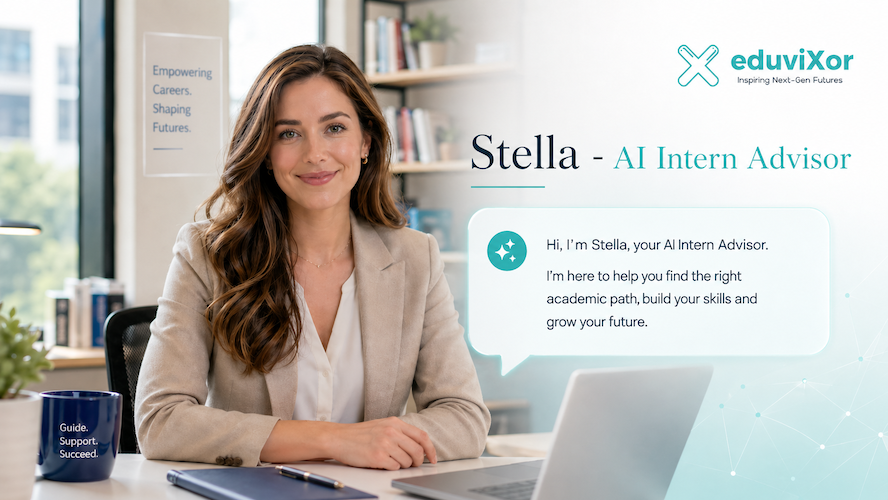
EduviXor is not trying to be an old-school agency with a chatbot attached. It is also not trying to replace real advisory work with a pure-AI answer box.
The model is designed around three layers:
That matters because education planning is no longer just about choosing a school. Families now have to think about AI-era careers, international mobility, program outcomes, cost pressure, and whether a student is building a future-ready path instead of chasing a familiar name.
EduviXor’s public positioning is also clear about one important point: AI should be a launchpad, not the final roadmap. The platform gives families a fast first-pass view of options, but the deeper planning work still involves human judgment.
Source: EduviXor - Education and Career Planning for the AI Age
Here is the simplest way to compare the three models.
Best for fast answers, brainstorming, rough comparisons, and helping families understand the basics. Weakest when the question requires emotional context, judgment, policy interpretation, or responsibility for the final recommendation.
Best when the consultant is experienced, ethical, and personally involved. Weakest when the process becomes too dependent on personal memory, limited school networks, partner commissions, or outdated manual research.
Designed to combine both strengths. AI helps families start faster and compare information more efficiently. Human advisors review the student’s real situation, pressure-test the options, explain trade-offs, and build a more complete academic and career roadmap.
The difference is not only technology. It is responsibility.
A pure-AI tool gives an answer. A traditional consultant may give an opinion. EduviXor aims to give families a more structured planning process, where AI supports the research but human judgment shapes the final direction.
Source: EduviXor - Education and Career Planning for the AI Age | Journal of Learning Analytics - AI-Augmented Advising
If you want a simple rule, use AI-only when the question is simple, early-stage, and low-risk.
Examples include:
Use a hybrid model when the decision affects cost, admission strategy, visas, work rights, or long-term career direction.
Examples include:
Use human-led guidance when the situation is unusually sensitive or complex.
Examples include weak profile recovery, family disagreement, special learning needs, high-risk applications, regulated career planning, or major financial trade-offs.
This is the practical line families should draw. AI is a useful assistant. It should not become the only decision-maker.
EduviXor is built for that middle ground.
Start with the free AI Advisor to get a fast first-pass view of your options. Then move to a human-reviewed report or consultation when you need someone to pressure-test the shortlist, explain the trade-offs, and help your family make a decision with more clarity.
Because in the AI age, the goal is not to replace human judgment. The goal is to make better decisions with better tools.





.webp)
.webp)

.webp)
.webp)