
Germany gave the world quantum physics, blue jeans, and Adidas. Here is what that tradition of innovation means for its industries today — and why it matters for international students.


Few countries have shaped the modern world as quietly and thoroughly as Germany. The science that underpins your smartphone, the jeans you are wearing, the sportswear brand on your shelf... all of these trace lines back to German inventors, entrepreneurs, and researchers who built things that outlasted them by generations.
That tradition has not faded. In 2026, Germany remains one of the world’s largest economies, home to industries that define global standards in engineering, chemistry, software, and manufacturing. For students and families weighing where to build a future, understanding what Germany is — not just as a country, but as a system of innovation — is a meaningful starting point.
Germany’s relationship with science is not a matter of historical pride alone. It is a living institutional culture, sustained through universities, research institutes, and industry partnerships that have consistently produced world-class discoveries across disciplines.
Since the Nobel Prize Foundation was established in 1901, German physicists and scientists have been among the most decorated in the world. Twenty-eight Nobel Prize laureates in physics have come from Germany — a figure that places the country among the top nations in the history of the prize. These are not clustered in one era. They span the full history of the award, from the early pioneers of quantum theory to contemporary researchers in condensed matter and optics.
Chemistry tells a similar story. Hermann Emil Fischer, one of Germany’s most celebrated scientists, received the Nobel Prize in Chemistry in 1902 for his foundational work on the synthesis of glucose and purine. Fischer’s discoveries opened the door to modern biochemistry, the structural understanding of sugars, proteins, and the building blocks of DNA that we now take for granted. His work is still a standard part of university chemistry curricula worldwide.
In 1929, the Nobel Prize in Chemistry was awarded for breakthrough research into the enzymatic fermentation of sugar. The prize recognised work that had built directly on decades of investigation by German research institutions into how living organisms convert carbohydrates into energy, findings that would eventually underpin modern food science, biotechnology, and pharmaceutical manufacturing.
This scientific depth is not accidental. Germany invests heavily in research infrastructure: the Max Planck Society alone operates 86 research institutes across the country, and the Fraunhofer Society runs 76 applied research centres. Together, they represent one of the most deliberately constructed knowledge ecosystems on earth.
Source: Nobel Prize Foundation | Max Planck Society | Fraunhofer Society
.webp)
Germany’s contribution to global culture is not limited to the laboratory. Two of the most recognisable brands in everyday life - products worn by hundreds of millions of people across every continent, trace their origins to German founders who combined craft, tenacity, and an instinct for what people actually needed.
Levi Strauss was born in Buttenheim, a small town in Bavaria, in 1829. He emigrated to the United States in his late teens, eventually settling in San Francisco during the California Gold Rush. In 1853, he established the business that would become Levi Strauss & Co., and within two decades, had co-created the first pair of riveted denim work trousers: the blue jean. What began as workwear for miners became a defining symbol of American culture, and eventually global youth culture. Today, Levi Strauss & Co. operates in more than 110 countries and remains one of the world’s largest apparel companies. The company was built by a Bavarian immigrant who understood that durable, practical clothing was worth making extremely well.
Adolf “Adi” Dassler’s story never left Germany. He grew up in Herzogenaurach, a small town in Bavaria, and began making sports shoes by hand — famously starting in his mother’s laundry room in the 1920s, using whatever materials were available. His shoes were good enough to catch the attention of professional athletes, including Jesse Owens, who wore Dassler’s hand-crafted spikes at the 1936 Berlin Olympics. In 1949, Adi formally founded Adidas, named from his own nickname and surname. The company is now one of the two largest sportswear brands on the planet, with sales across more than 160 countries and partnerships with the world’s most prominent sporting institutions.
What both stories share is a particular German quality: a commitment to the craft itself, a belief that doing something properly — whether it is stitching denim or designing a running shoe sole — is its own argument. That orientation toward precision and long-term product thinking runs through Germany’s industrial culture today.
.webp)
Germany’s economy is the third largest in the world by GDP and the largest in Europe. Its industrial base is genuinely diversified — and in 2026, several sectors are growing, transforming, or both.
The automotive industry remains Germany’s largest industrial sector by turnover and export value. BMW, Mercedes-Benz, Volkswagen, Porsche, and Audi are all German, and collectively they define what premium vehicle engineering means globally. The sector is in the middle of a significant transformation toward electric vehicles, battery technology, and connected mobility — creating sustained demand for electrical engineers, software developers, materials scientists, and supply chain specialists.
Germany’s chemical industry is among the most productive in the world, with companies like BASF and Bayer operating at truly global scale. The sector feeds into pharmaceuticals, agricultural science, advanced materials, and industrial manufacturing. It is one of the clearest examples of where scientific research and commercial production are fully integrated in a single national ecosystem.
Software and IT have become central pillars of the German economy. SAP, founded in Walldorf in 1972, is now one of the world’s largest enterprise software providers, and Germany’s broader technology sector is expanding rapidly. Computer and electronics manufacturing grew by 3.9 percent in 2025, while machinery production expanded by 2.8 percent over the same period. Germany’s 5G rollout, cloud infrastructure investment, and growing cybersecurity sector make this one of the most active areas for skilled international graduates.
Three further sectors round out Germany’s economic profile. Telecommunications — covering internet infrastructure, mobile networks, and connectivity services — is a significant employer and investor in the country’s digital future. Real estate encompasses the development, leasing, and management of residential and commercial property across Europe’s most populous nation. And insurance — led by globally significant firms like Allianz and Munich Re — provides the risk management infrastructure that supports all of the above.
Source: Germany Trade & Invest (GTAI) 2026 | Federation of German Industries (BDI) | Statista Germany Industry Report 2025
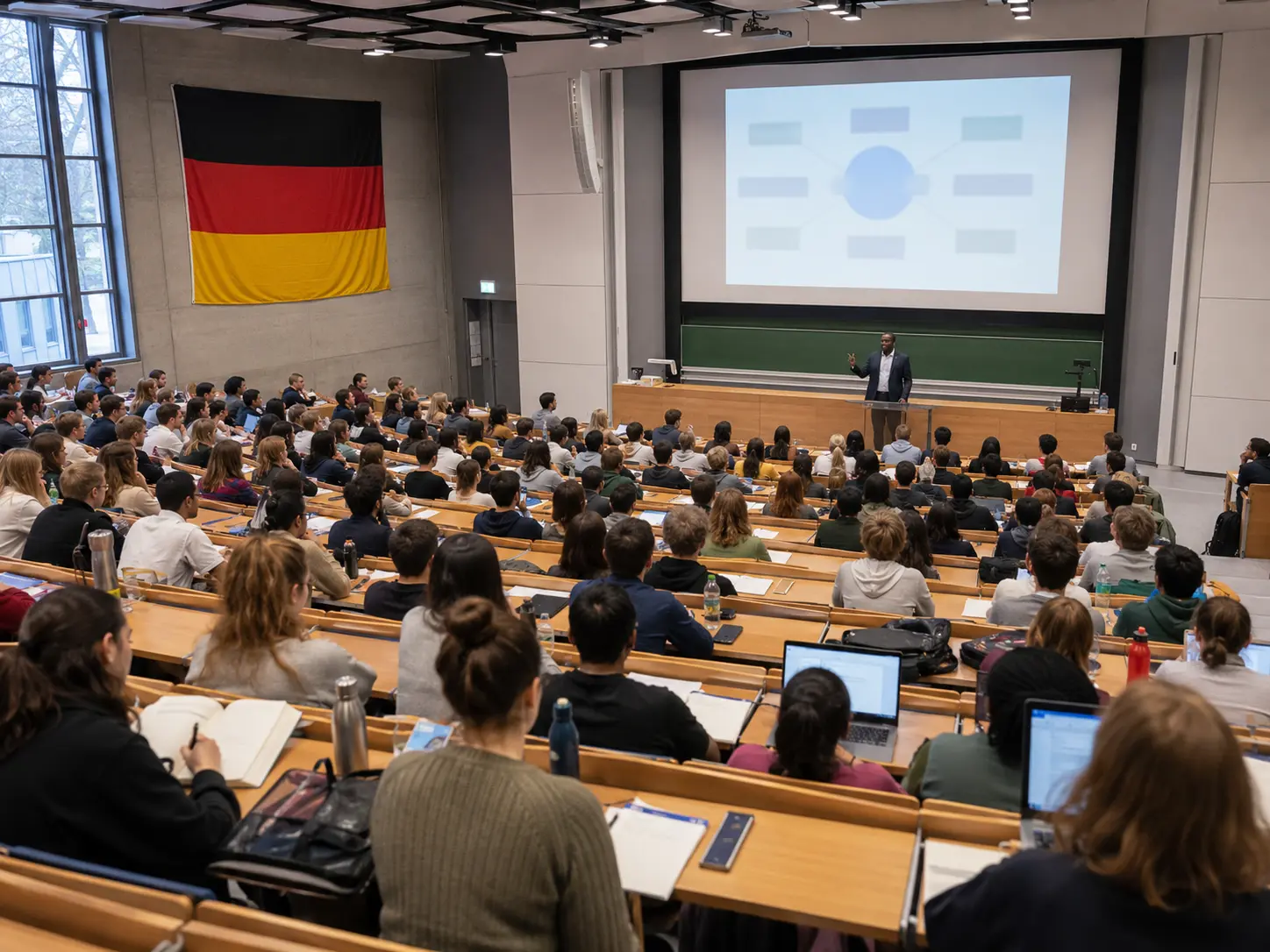
Germany’s industrial and scientific profile is not background context for international students — it is a direct argument for why studying here produces something tangible.
Public universities in Germany charge no tuition fees for undergraduate programs in most of the country’s 16 states, including for international students. Students pay only a semester administrative fee, typically in the EUR 150–350 range per semester. That makes Germany one of the most cost-effective degree destinations in the world, particularly when combined with the strength and global recognition of its programs in engineering, computer science, chemistry, business, and the natural sciences.
The graduate job market is directly connected to the industries above. Engineering graduates from German universities are recruited by automotive and industrial firms across Europe. Computer science graduates enter one of the continent’s most active tech ecosystems. Chemistry and life science graduates have access to one of the world’s largest chemical and pharmaceutical sectors.
Germany’s Job Seeker visa allows international graduates 18 months to find employment after completing their degree. The country’s skilled worker immigration pathway is among the most structured in Europe, and the government has been actively expanding pathways for qualified foreign professionals.
If you are still working through which study destination fits your child’s academic profile and long-term goals, our guide to choosing the right university abroad breaks down the complete decision framework — including how Germany compares to Canada, the UK, Australia, the US, Japan, and South Korea across program fit, cost, and post-study opportunity.
A dedicated guide to studying in Germany — top universities, English-medium programs, application requirements, and language pathways — is coming soon.
Source: DAAD German Academic Exchange Service | Hochschulkompass | Make it in Germany — Federal Employment Agency
Germany’s combination of no tuition fees, world-class research universities, and one of Europe’s strongest graduate job markets makes it one of the most compelling study destinations for students who are willing to plan carefully — particularly those with a clear interest in engineering, technology, science, or business.
The EduviXor AI Advisor can map your child’s academic profile and career direction against specific German universities and programs — identifying the right institutions, language requirements, and scholarship options based on what your family is actually working toward.
If you would like an advisor to walk through Germany as a study option alongside other destinations, our team is available for a free discovery call. No generic shortlists — just a clear, specific conversation about what the right path looks like for your child.





.webp)
.webp)
.webp)
.webp)
.webp)